
A useful mobile roadmap is a decision system for what a company will build, delay, refine, or remove based on the problems people repeatedly need solved. For Codebaker, that means treating utility apps not as isolated products, but as a connected set of tools built around document handling, trusted communication, and reliable task completion on a phone.
That distinction matters because many apps grow by accumulation. Features pile up, interfaces get heavier, and the product drifts away from the reasons people downloaded it in the first place. A better path is to stay close to the underlying job: scan docs clearly, send a fax without friction, keep a second number for work or privacy, and finish the task from a mobile device without confusion.
The long view: fewer categories, deeper utility
Codebaker is a company in a practical segment of the app market. Its apps include Scan Cam: Docs PDF Scanner App, Text & Call Second Phone Number, and FAX Send Receive (ad-free) App. On the surface, these look like separate tools. At the roadmap level, however, they point in the same direction: helping people complete necessary but often inconvenient tasks on mobile with less effort and more confidence.
The long-term direction is not to chase every trending software category. It is to go deeper in a small number of high-frequency, high-friction use cases. That usually leads to better product decisions. When a team knows exactly which real-world tasks it wants to support, it can judge features by a simple test: does this reduce time, uncertainty, or failure for the user?
That is especially relevant in utility software, where people are not looking for novelty. They want dependable output. A document scanner should capture legible pages in imperfect lighting. A second-number app should make text and calling straightforward. A fax app should preserve formatting and confirm transmission status clearly. Reliability is not a supporting detail in these categories; it is the product.

What users are actually hiring these apps to do
Roadmaps become clearer when products are defined by user jobs instead of feature labels.
Someone opening a scanner app is usually not thinking, “I need image enhancement.” They are thinking, “I need to submit this form in ten minutes,” or “I have to digitize receipts before I lose them.” The same applies to communication tools. People rarely search for a second number because they love telephony settings. They want a boundary between personal and business use, or a temporary line for listings, deliveries, signups, and client contact.
For that reason, a roadmap tied to user needs tends to organize around a few enduring jobs:
- Capture and share paper information accurately
- Communicate from a separate number without adding hardware
- Send official documents from a phone when a desktop process is too slow
- Store, retrieve, and resend important files without repeating work
Those needs hold across device generations, whether someone is using an iPhone 11, iPhone 14, or iPhone 14 Pro. Screen size, camera quality, and processing power change the experience, but not the reason the task exists. That is one reason roadmap planning should separate temporary device trends from durable user intent.
How product decisions map to those needs
In practice, roadmap thinking works best when each decision can be tied to a clear user outcome. That creates discipline. It also helps explain why some seemingly attractive features never make the cut.
Consider document workflows. If the goal is helping people scan docs quickly and accurately, then camera capture quality, edge detection, readability, file export options, and sharing speed deserve more investment than decorative customization. In Scan Cam, for example, the durable value comes from making the scanner dependable in ordinary conditions: a kitchen table, office desk, low-angle shot, or multi-page stack of receipts.
The same logic applies to communications. In a second-number app, users usually care about setup speed, message clarity, number reliability, calling behavior, and privacy management. They may also care about whether the app fits their carrier context, including common questions around services like tmobile. That does not mean the product should attempt to replace every carrier function. It means the roadmap should focus on the parts of the experience users control directly inside the app and make those parts predictable.
For faxing, the mapping is even sharper. People want confidence that a file was sent, received, and preserved correctly. That leads toward roadmap items such as cleaner upload flows, better status visibility, simpler resend actions, and support for common document formats. It leads away from distractions that do not improve transmission success or user trust.
A practical framework for evaluating roadmap priorities
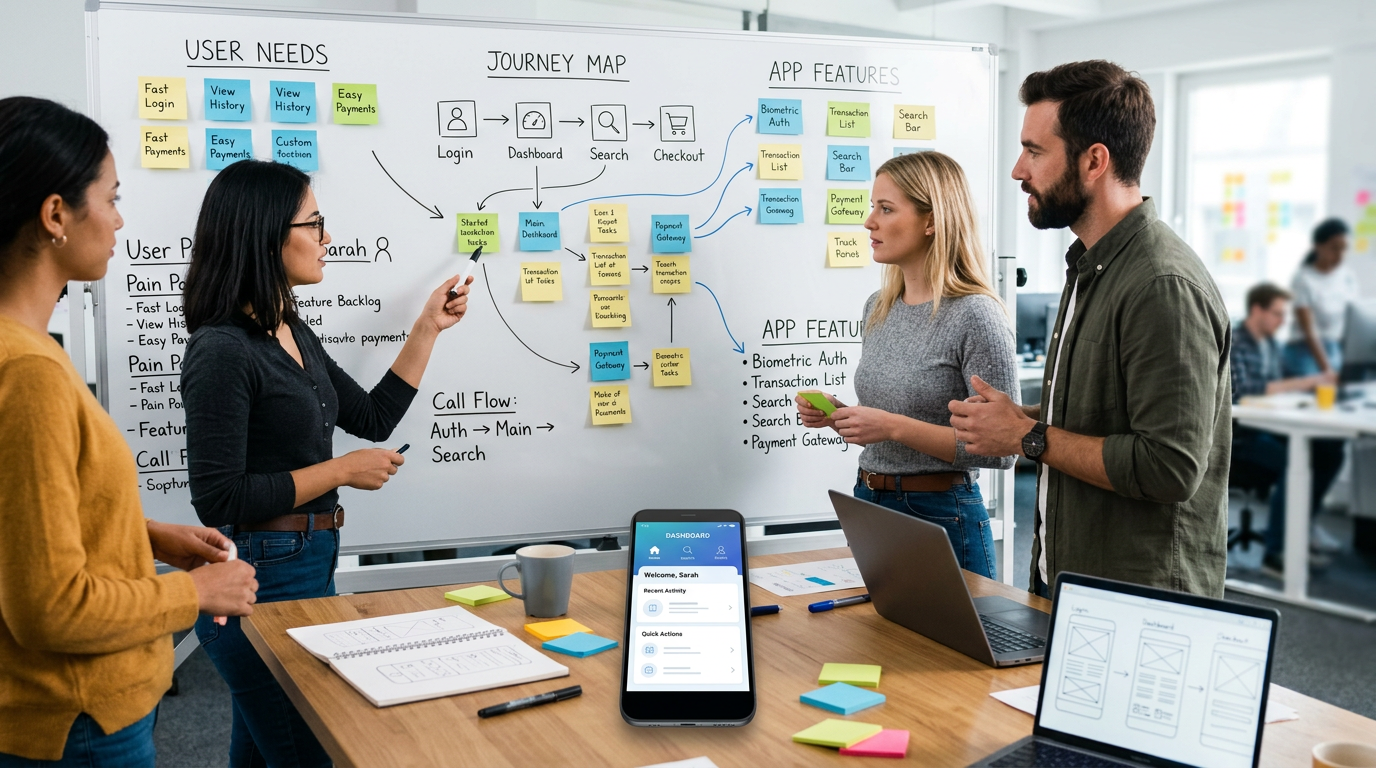
One useful way to evaluate mobile roadmap options is to put every proposed feature through four filters.
- Frequency: How often does the underlying user problem occur?
- Friction: How frustrating or error-prone is the current workflow?
- Urgency: Does the user need the task completed immediately?
- Compounding value: Does solving this once make future tasks easier too?
Features that score well on all four deserve serious attention. For example, better batch scanning scores highly because people repeatedly handle multi-page docs, scanning can be fiddly, the need is often time-sensitive, and an efficient flow saves effort every time after that. By contrast, a visually interesting but rarely used editing effect may add complexity without reducing meaningful friction.
This framework also helps a company resist roadmap drift. It is easy for apps to become bloated when feedback is interpreted too literally. Not every request reflects a strategic need. Sometimes a feature request is actually a symptom of a deeper issue, such as poor navigation, unclear labels, or too many steps in a core workflow.
Where the roadmap should stay flexible
A long-term product vision should be stable, but not rigid. User needs persist, while the way people expect to complete tasks changes over time.
Take device behavior. Users on an iPhone 14 Plus may prefer roomier preview screens for reviewing scanned pages, while users on smaller devices may care more about one-handed actions and faster confirmation states. The roadmap should adapt to those practical realities without losing focus. The principle is not “build for one handset.” It is “make the core task work well across common device contexts.”
Likewise, communication expectations shift. People increasingly expect immediate setup, visible control over notifications, and less ambiguity in number management. That suggests ongoing investment in onboarding clarity, account transparency, and messaging reliability. The product category may be mature, but user tolerance for friction keeps falling.
There is also a broader ecosystem reality: some tasks still bridge old and new systems. Faxing is the clearest example. Many people assume it is obsolete until a clinic, school, legal office, or government process requires it. A roadmap grounded in user needs accepts this without judgment. If the world still runs on mixed infrastructure, a useful mobile app should help people navigate that mix efficiently.
What not to build is part of the strategy
Roadmaps are often discussed as lists of future additions, but subtraction matters just as much. A disciplined company needs criteria for declining work.
Codebaker’s category focus suggests a healthy bias toward simplicity over sprawl. That means avoiding features that create support burden without improving completion of core tasks. It also means being careful with anything that slows down opening the app and getting started. Utility apps live or die by time-to-result.
For users, this restraint is usually invisible, but valuable. Every feature that is not added preserves attention for the ones that matter. In a scanner, fewer taps before export. In a text app, fewer uncertainties around number status. In a fax workflow, fewer chances to send the wrong file or miss a confirmation step.
That kind of product discipline is harder than it sounds. It requires a company to choose depth over breadth again and again, especially when the market rewards novelty in the short term. But for durable utility software, that tradeoff is often the right one.
Questions users often have about roadmap direction
Does a roadmap mean every requested feature is planned?
No. A roadmap should reflect recurring user needs, not a running backlog of every suggestion. Good planning looks for patterns across requests and usage behavior.
Why would a company keep investing in fax or scanning when phones already have cameras and sharing tools?
Because capturing an image is not the same as creating a usable document. People still need readable scans, structured PDFs, reliable delivery, and records they can retrieve later.
Should utility apps try to become all-in-one platforms?
Usually not. Most users benefit more from a focused app that finishes a task well than a broad app that handles many tasks poorly.
How does this affect existing products?
It typically leads to steady refinement of core workflows, better reliability, and clearer task completion rather than dramatic but unnecessary redesigns.
How this vision shows up across the product portfolio
The clearest sign of a sound roadmap is consistency across products. Not identical features, but shared product judgment.
In Codebaker’s portfolio, that judgment appears as a focus on practical completion: turn paper into usable digital docs, make communication more manageable, and handle official document sending from a phone. Those use cases are not glamorous, but they are persistent. People encounter them at work, during travel, in healthcare, with schools, in side businesses, and in personal admin.
That is why a vision-led roadmap matters. It keeps a company from mistaking noise for demand. It also helps users know what to expect. If the product philosophy is consistent, improvements feel coherent rather than random.
For readers interested in the scanning side of that portfolio, Scan Cam: Docs PDF Scanner App is a practical example of how a scanner can stay focused on readable capture and straightforward export. And for communication needs that require a separate line, Text & Call Second Phone Number reflects the same preference for utility over excess.
Long term, the most credible roadmap for a mobile company is not the one with the most ambitious slide deck. It is the one where each product decision can be traced back to a real need, a repeated task, and a clearer outcome for the user. That is a practical standard, but it is also a durable one.