Codebaker’s portfolio includes document and communication utilities. A long-term roadmap should connect changes to practical tasks, such as scanning files or using an additional phone number, and distinguish proposed improvements from features already released. Review Scan Cam: Docs PDF Scanner App for current product details and supported features.
Roadmaps can lose focus when they follow technology trends without a defined user task. Evaluate proposed capabilities through usability, reliability, operating cost and supported-device testing rather than projected market value.
Why Do Shifting Industry Dynamics Require A New Roadmap Framework?
Traditional software planning relies heavily on static feature pipelines. However, according to Anthropic’s 2026 Agentic Coding Trends Report, the software development lifecycle is changing dramatically. Development is moving away from isolated coding tasks toward long-running, automated agents that can build and coordinate complete systems. For a mobile app company like ours, this means the underlying methods we use to write, test, and deploy code are fundamentally different today than they were two years ago.
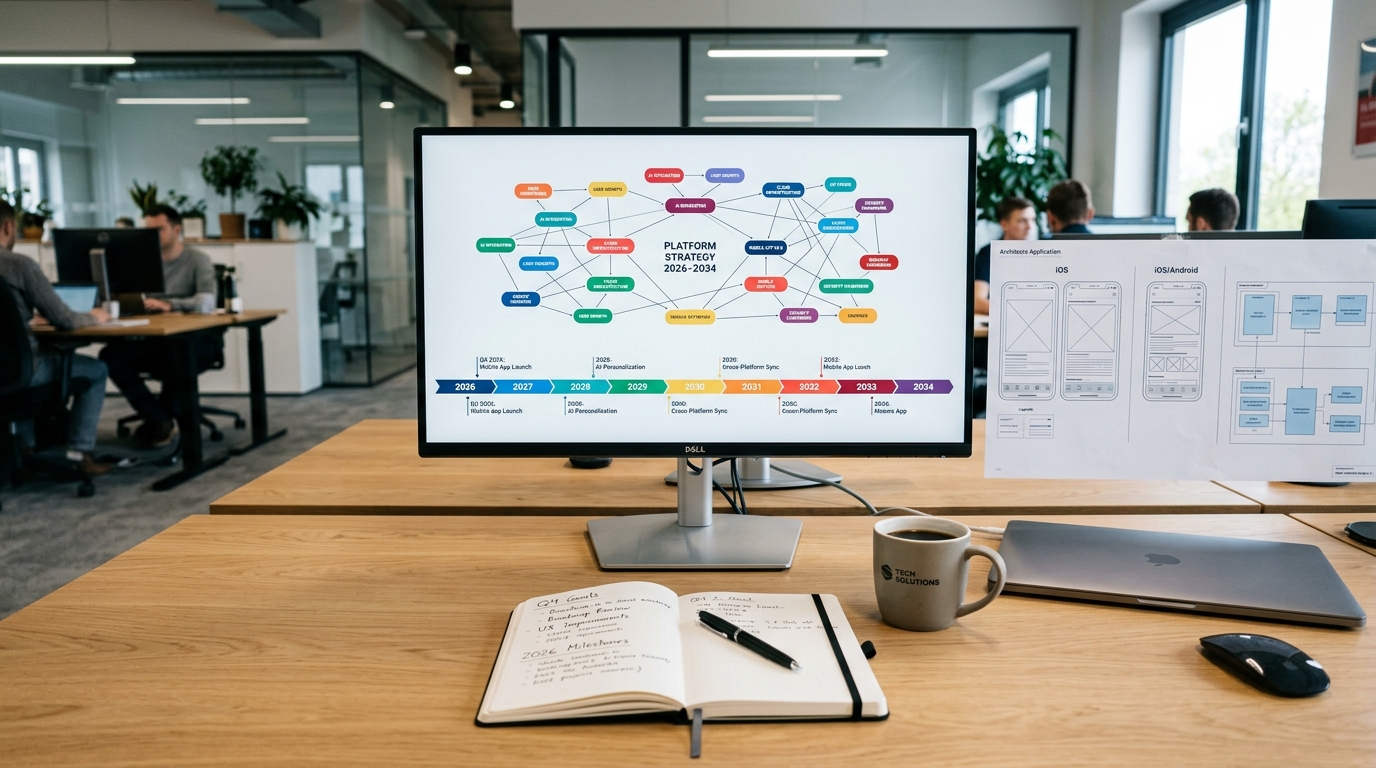
Rather than merely updating our apps with superficial design changes, our vision requires a systematic restructuring of our backend operations. We have broken this long-term strategy down into a practical, five-step progression that dictates how we engineer, deploy, and refine our tools for everyday professionals.
How Do We Define Step 1: Transitioning Toward Coordinated Software Architectures?
The first step in our roadmap is shifting our infrastructure to support coordinated technical teams. The Anthropic report highlights that single automated agents are rapidly evolving into coordinated teams that manage different layers of a software stack. Translating this to our product environment means breaking down our monolithic architectures into specialized, communicative microservices.
Communication services need monitoring, bounded retries and tests for registration, notification delivery and interrupted connections. These are engineering goals; a proposed architecture does not establish a measured uptime improvement or eliminate dropped connections.

What Is Step 2: Prioritizing Security-First Architecture In Mobile Communications?
Trend eight from the recent Agentic Coding Trends Report emphasizes that dual-use risks require security-first architectures. Step two of our roadmap focuses intensely on this mandate, particularly for our communication platforms. When individuals rely on digital communication, they expect absolute data isolation.
In practice, if you are operating our Text &Call Second Phone Number service over a standard cellular network like TMobile, Verizon, or a public Wi-Fi access point, the routing protocols must shield your primary identity and data payload. We are implementing stricter, zero-trust verification layers at the API level. This step involves stripping metadata from outgoing transmissions and ensuring that VoIP packets are securely encapsulated. As Onur Başaran explored in his breakdown of the engineering reality behind utility software, providing a seemingly simple interface requires a highly complex, hardened security framework beneath the surface. Our roadmap dedicates a massive portion of our 2026 engineering hours solely to stress-testing these security protocols against emerging vulnerabilities.
How Are We Executing Step 3: Aligning Broad Hardware Compatibility With Utility?
Step three addresses hardware fragmentation. A practical roadmap cannot strictly target users with the newest, most expensive flagship devices. True utility requires broad compatibility across various generations of hardware.
A scanning workflow must support the camera capabilities of each supported device. Focus, lighting and image quality matter; camera specifications vary by model, so test actual hardware rather than assuming every newer phone includes a telephoto lens.
Document capture should be tested for focus, lighting, page edges and readability across supported devices. Camera and sensor capabilities vary by model; do not assume depth data or identical performance on every phone.

Why Is Step 4: Structuring Economic Productivity Around Recurring User Jobs?
Step four of our vision maps our product enhancements directly to productivity economics. The Anthropic report notes that productivity gains are fundamentally reshaping software development economics. Instead of bloating our software with experimental additions, we direct these efficiency gains toward refining recurring user jobs.
A roadmap may prioritize OCR, memory use and locally available operations. Distinguish proposed improvements from released capabilities: scanning or viewing a saved file may be local, while sending a fax or communicating through a provider requires a service connection.
What Does Step 5: Establishing Scalable Human Oversight Mean For Everyday Users?
The final step in our strategic roadmap involves implementing scalable human oversight. As backend systems become increasingly automated and capable of handling complex routing and data structuring, maintaining transparent user control becomes vital. Trend four in the 2026 coding trends analysis points to human oversight scaling through intelligent collaboration.
Transparent interfaces should explain a proposed action, required permissions and possible errors. Document-scanning guidance and communication settings are planning examples; recording availability and consent must be checked in the current product and relevant context.
How Will This Vision Materialize Over The Next Fiscal Year?
By executing these five specific steps—adapting to coordinated software systems, hardening security architectures, ensuring broad hardware compatibility, focusing on recurring jobs, and maintaining human oversight—Codebaker is well-positioned for the significant market expansion projected for 2026 and beyond.
Prioritize updates that improve a defined user task and validate them before release. This is a product-planning principle, not a guarantee of uninterrupted service or universal reliability.